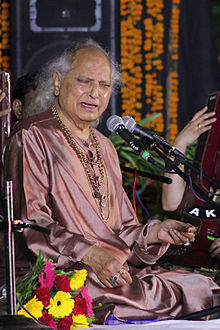
Life with Pandit Jasraj
Pandit Jasraj and his late disciple, the poet-thinker Mukund Lath, were renunciates who lived the philosophy of the Upanishad
The disciple, friend and reclusive philosopher, departed first. The guru, the guide, the celebrity, followed in little more than a week, slightly reversing the order. Mukund Lath, singer, painter, Sanskritist, historian of Indian music and musicology, moral philosopher of the Mahabharata , art collector, and above all, poet-thinker ( kavir maniishii ), passed away on August 6. Within 11 days, Pandit Jasraj, who had taught Hindustani classical music to Mukund for at least five decades, breathed his last, 10 years short of a century. Close friends, they were also guru-bhais because both had sat at the feet of Pandit Maniram, Jasraj- ji ’s eldest brother.
That double epithet kavi-maniishii is applied to the supreme Isha who dwells in and clothes and perfumes all that changes in this whirling world, à la the first verse of the Isha Upanishad . While a deadly virus plays havoc by making an unsocial ‘distancing’ from one another globally mandatory, that first verse continues to teach us how to enjoy by giving up. Mukund left this earth just in time before not sitting close to one’s teacher — un-Upanishad — became the new normal.
Pandit Jasraj had initiated the brilliant adolescent Mukund into a gaana-yajna , which was simultaneously the art of offering away one’s intellectual/ academic ego, one’s vocal breath rising from one’s navel, and one’s emotional energy — all into the all-consuming mother of all flames: Maataa Kaalikaa. That first verse of the Isha Upanishad changed the life trajectory of Debendranath Tagore, the prodigal-merchant-turned-contemplative-saint father of Rabindranath. And it urges us to enjoy and suffer the beauty and the riches, the viruses and the vicissitudes of this world, by means of “sacrifice”.
The last sacrifice is the offering up of one’s bodily life at the altar of Time, who reveals himself as “decimator of people” in the 11th chapter of the Bhagavad Gita . That most famous song sung and recorded by Jasraj- ji , which I first heard in Mukund’s voice, calls Kali the Mother “the great queen of Time the great” ( Mahakala Maharani ), opening with an arduous ascent in raga Adana and always finding a triplicate repose in the mantric repetition of bhavaani, bhavaani, bhavaani .