Mukund Lath
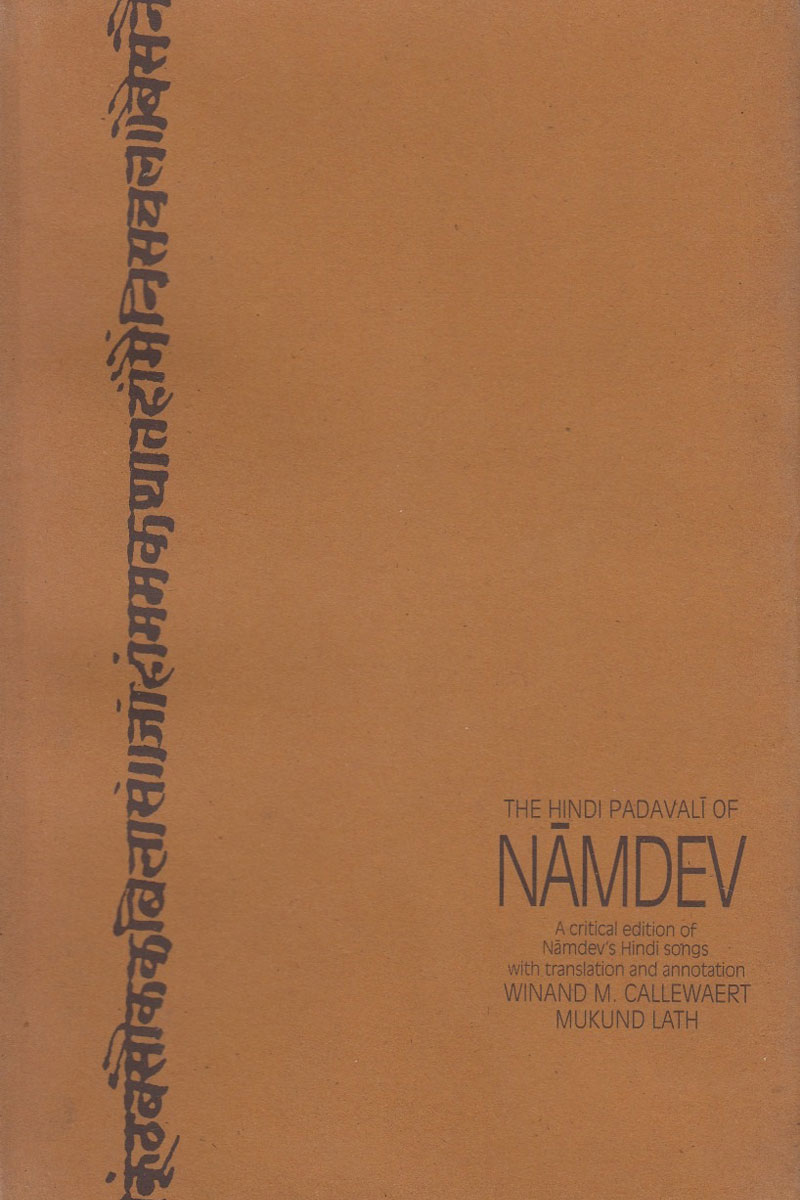
THE HINDI PADAVALI OF NAMDAV
Nāmdev, who lived in the 14th century, was one of the greatest saint-poets of Maharashtra. Besides numerous songs in Marathi, tradition ascribes to him songs in Hindi too. Nāmdev's Hindi songs breathe a spirit quite distinct from his Marathi compositions and are considered the oldest expressions of the Hindi nirgun strain of bhakti poetry. According to his 16th century 'biographer' Anantdas, Nămdev was the first among the nirgun greats and stood at the threshold of the remarkable religious and poetic movement which later produced men like Kabīr, Raidās, Nānak and Dādū.
Almost all of the greatest Hindi nirgun poetry is riddled with problems of authenticity. The historical and scholarly quest of identifying songs which Nāmdev, Kabir or Raidās actually composed from out of the bewildering many that survive in their name, both in oral and written transmission, has exercised i many modern minds. But no satisfactory answers are yet at hand.
Greater reliance, naturally, has been placed on written manuscripts, the earliest written collection being the Guru Granth. But as far as Nāmdev (also Kabir and Raidās) are concerned, the Guru Granth is clearly a selection and thus an incomplete guide.
Another store of old written materials comes mainly from Rajasthan. However, modern scholarship has yet to make full use of the earliest of this written store-house. What have been examined so far are usually later manuscripts with the usual text-critical presumption that they can lead us back to the unique and authentic version of a poet's work.
This presumption, our study shows, is a myth. We have been able to expose this myth with the help of the rich microfilm collection of nirgun manuscripts in Leuven, Belgium (along with a suitable computer). This collection contains the earliest manuscript records of nirgun songs and has been text-critically examined here for the first time with an eye towards explaining the original Nāmdev.
Inescapably, we are led to the conclusion that the original must remain tantalisingly elusive. One reaches for a written record in order to escape the uncertainties of the oral. But in the earliest nirgun manuscripts, what we are faced with is the oral tradition itself which we had hoped to escape through the written. The earlier nirgun manuscripts are records of oral repertoires as they stood in the 16th century. These were repertoires transmitted by organised bands of musicians whose records were essentially oral, as they still are. The repertoires are interconnected and our study is an attempt at examining the interrelations betwen these repertoires with a view to arriving at an oral stemma and drawing significant text-critical clues from the fact that the transmission was in a musical tradition, which is different in important ways from the poetic. In our study, history of poetry accosts the history of music, long neglected in such studies.
We have also made an English translation of a select number of Nāmdev's songs, those that we consider as belonging to the oldest strata. But we have not really taken sides in this matter and our collection contains all of Nāmdev's available Hindi songs which we have noted with pāthabhedas.
An authentic biography of Nāmdev presents as many problems as his songs. We have tabulated a detailed picture of how his 'biography has grown with time acquiring more and more hagiographic details till in the modern period, with a growth of the taste for the historical, it also began to acquire a historical visage.