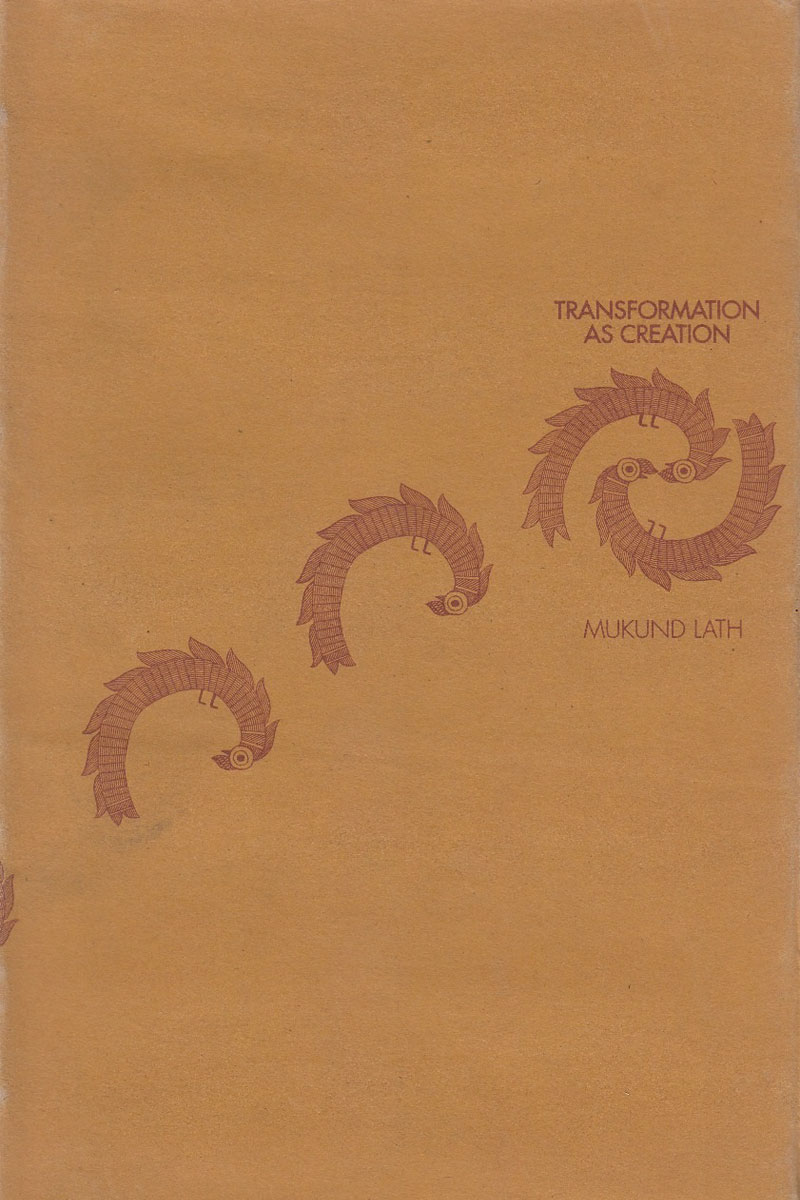
Mukund Lath
TRANSFORMATION AS CREATION
written over a period of two decades, these essays present an important part of the work of Dr. Lath after his, A Study of Dattilam, published in 1978 and now considered a land-mark in musicology. Lath has since widened his interests and the essays here cover a large range of subjects, extending beyond music into dance and theatre, on which he has written with equal theoretical sensitivity and historical insight. Moreover, as the reader will discover, the range of his concerns has not only widened but also deepened. He asks himself questions that lead beyond the narrow confines of descriptive musicology into thought in general. This expansion of the field, however, remains true to the spirit of Indian musicology, which, unlike many other disciplines remains Indian. Lath's own thinking is creatively rooted in Indian ideas.
The first essay deals with the question of the ‘modernity of our classical music. This leads to the question of creativity and its relation to music, which is the subject of the second essay. The discussion creatively uses the ideas of the famous theorist and critic, Anandavardhana who had raised a basic question a millennium ago: Is new poetry possible?
The subject of many of the ‘historical essays collected here is the history of thinking about art in India. They ask new, atypical questions. “Bharata Muni and Hindi Films' relates the use and aestheties of song and dance in our popular films to the Natyaśāstra. Another monographlike essay on the Natyaśāstra, ‘Bharata' and the Fine Art of Mixing Structures', articulates its unique theoretical approach and structure as a śāstra concerning theatre making as a 'composite' art. ‘Tandu: The first Theoretician of Dance', deals with a neglected masterwork of ancient theory. Unlike Bharata, Tandu, who is perhaps as old as Pānini, and the author of the first sastra on dance in the world was interested in defining and describing a pure and abstract art form.
The other essays too, some of which have already made marks in their field, manifest a critical sensibility tuned both to history and to thought. There are in-depth historical studies, which ask new questions and break new ground: on the early history of Rāgamālā painting; the musical antecedents of the Gitagovinda and the Vīnā of Samudragupta. A translation and study of a small, but important, ancient Jain tract on music is also included in the collection.
The last essay, written especially for this collection, is an attempt to extend the idea of ‘musicology by way of a discussion of the concept of 'logos' in relation to music.
Mukand Lath (b. 1937) grew up in Calcutta studying music with Pandit Maniram, Pandit Ramesh Chakravarty and Pandit Jasraj, whose disciple he is. He did BA (Honours) in English and moved on to Sanskrit, in which he did his Ph.D., working on an ancient text on music: published as A Study of Dattilam. He then joined the Dept. of History and Indian Culture, University of Rajasthan, Jaipur where he is teaching. Writing in both Hindi and English, he has published a number of books and articles on music, theatre and dance as well as history, culture and thought in general. His last book, Sangita Evam Chintan, is a unique attempt to reflect on thought on the analogy of music.